 World Clock
Will I see the solar eclipse?
Compare the eclipse path with your location and read the time of maximum coverage where you plan to watch.
Where to find itTools › Sky › Solar eclipses. You can also open eclipses from Location or a city’s page.
Choose an eclipse
Tap an event in the timeline below the globe or map. Use Next eclipse to return to the next event, or load earlier and later events at the ends of the list. Open an event to see whether it is partial, annular or total. An annular eclipse leaves a ring of sunlight around the Moon.
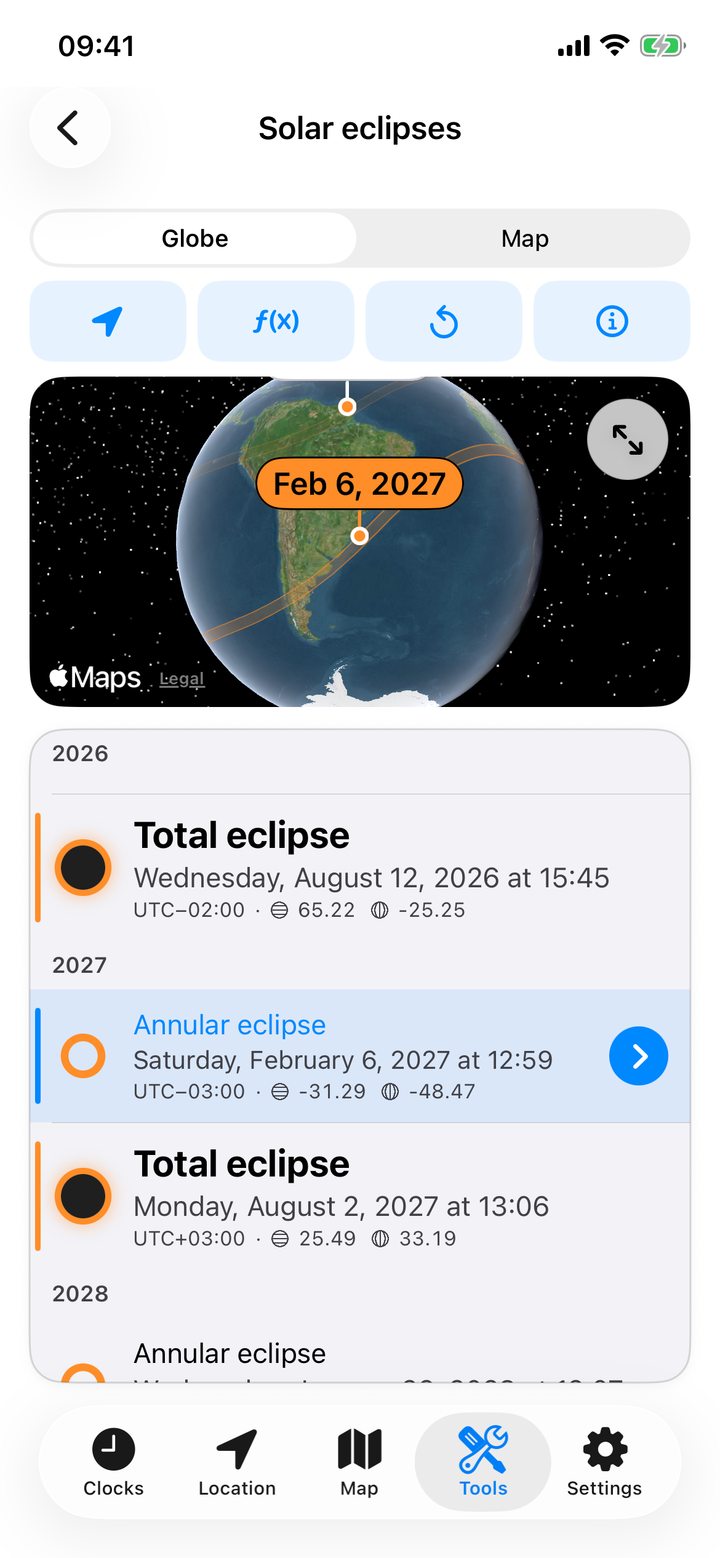
See where it is visible
Switch between Globe and Map to follow the path across Earth. Find your chosen location. The broad shaded area marks partial visibility. When a central path exists, the narrow band shows where observers can see a total or annular eclipse. A city outside that band can still see a partial eclipse.
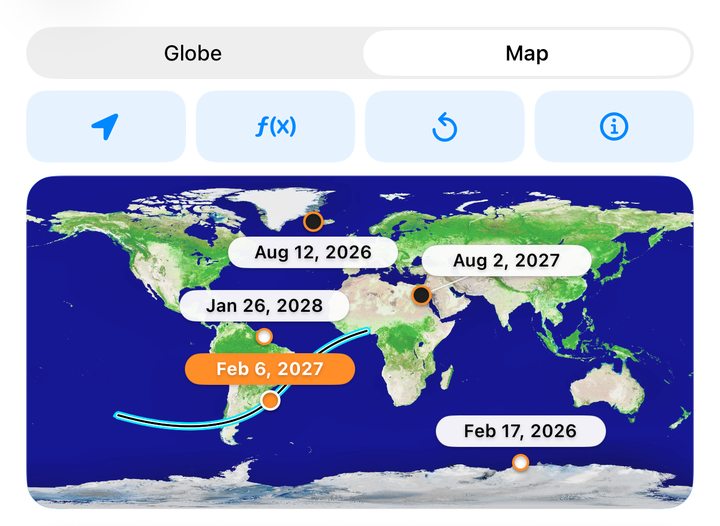
Read the times for your location
- Use Local solar eclipse for your location or a place you select. Open an event’s details for conditions at the point of greatest eclipse. Greatest eclipse describes a particular point on Earth. Select your observing location for the times you will experience.
- Choose GMT, device time or the time zone of the observing site. Check that choice before making a note of the time.
- Read the start of the partial phase, maximum and end. At places on the central path, also check when the total or annular phase begins and ends.
Obscuration is the fraction of the Sun’s disk covered by the Moon. The details also give the duration and the Sun’s altitude and azimuth, so you can tell where to look.
Watch the shadow move
Play the eclipse animation to follow the shadow across Earth alongside the Sun and Moon as seen from the selected point. Pause, change speed or move to a specific instant to compare the map with the local view.
Protect your eyes
Use proper solar viewing glasses when looking at the Sun during the partial or annular phases. Ordinary sunglasses do not provide adequate protection. Read the app’s solar observing safety section before viewing.